What Year Did Chevy Start Active Fuel Management
If you own a Chevrolet Silverado, Tahoe, Suburban, or Camaro, you may have heard about Active Fuel Management (AFM) and wondered:
What year did Chevy actually start using AFM?
This is a very common question—especially if you're buying a used GM truck, trying to understand engine behavior, or checking compatibility for AFM-related products.
The answer is not a single year, because GM introduced AFM gradually across different models and engine types.
Let’s break it down clearly.
Answer: When Did Chevy Start AFM?
Chevrolet first introduced Active Fuel Management (also known earlier as Displacement on Demand) around the 2005 model year on select engines and vehicles.
However:
2005–2006: Early adoption on select Chevy cars and SUVs
2007: Widespread introduction on Silverado, Tahoe, Suburban, Avalanche
2010+: Expanded use in Camaro and other V8 platforms
2014+: EcoTec3 generation continued AFM on modern trucks/SUVs
2019+: Transition toward DFM (Dynamic Fuel Management) in new Silverado platforms
The most important takeaway:
For most Chevy truck owners, AFM becomes highly relevant starting from the 2007 model year onward.
What Is Active Fuel Management (AFM)?
AFM is GM’s cylinder deactivation system.
In real driving terms:
A V8 engine can temporarily run as a V4
It activates during light-load cruising
It switches back to V8 when power is needed
The goal is simple: improve fuel economy during highway driving.
But many owners only notice AFM when they feel:
Slight engine vibration at cruising speed
Subtle change in exhaust tone
V4/V8 switching behavior
Or after reading about AFM lifter concerns.

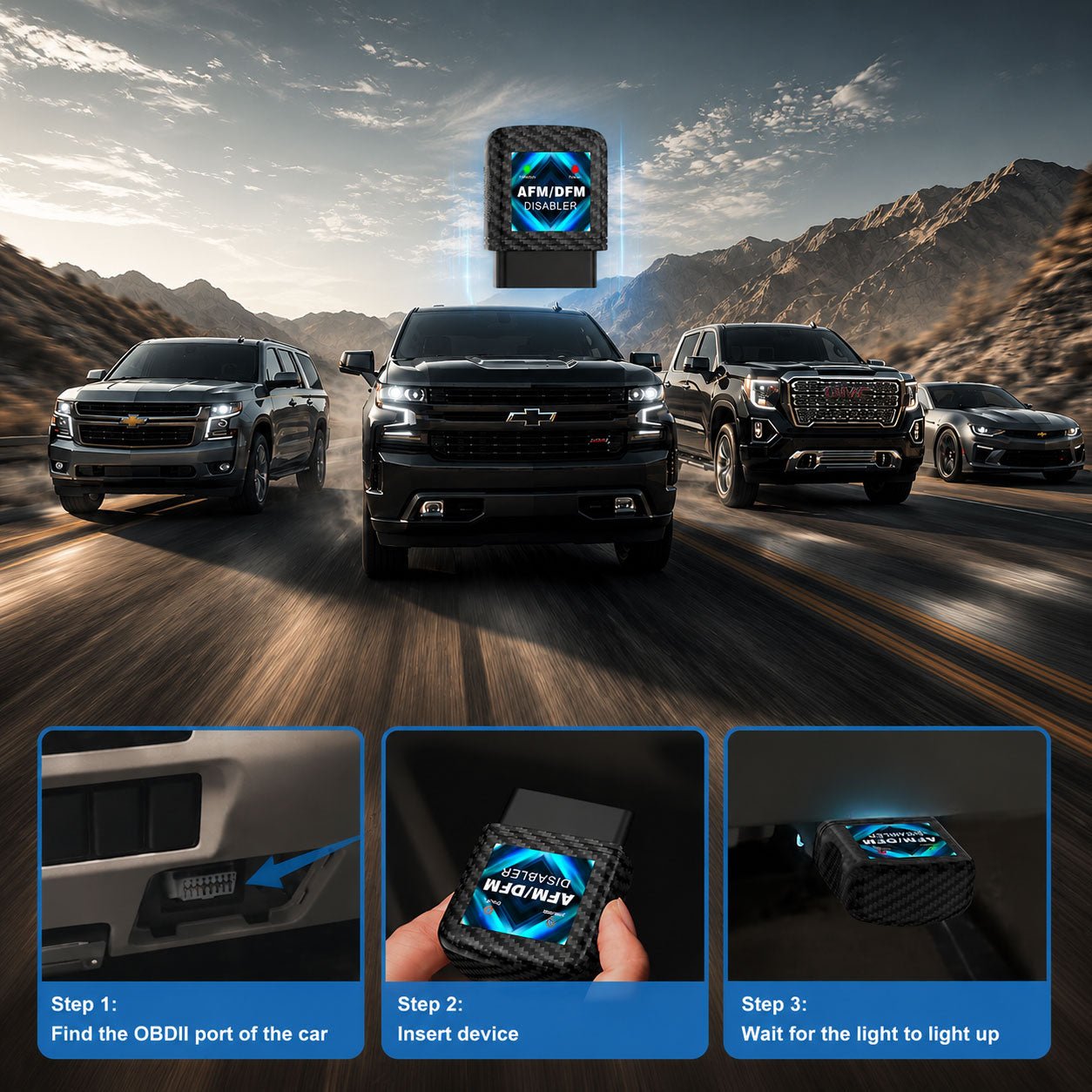
AFM/DFM Disabler compatible with multiple vehicle brands
Chevy AFM Timeline by Year (Real-World Breakdown)
Instead of guessing, here’s how AFM actually rolled out across Chevy models:
2005 – Early introduction
Limited GM vehicles using AFM / Displacement on Demand
Example: 5.3L V8 applications in select SUVs
2006 – Expanded early use
More passenger cars and performance variants
Example: Impala SS / Monte Carlo SS (5.3L V8)
2007 – Major rollout (MOST IMPORTANT YEAR)
This is the key year for most truck owners.
AFM becomes widely used on:
Chevrolet Silverado 1500 (select trims)
Chevrolet Tahoe
Chevrolet Suburban
Chevrolet Avalanche
👉 This is when AFM becomes mainstream in Chevy trucks and SUVs.
2010 – Performance expansion
Camaro SS automatic (L99 engine) with AFM introduced
2014 – EcoTec3 generation
5.3L and 6.2L EcoTec3 engines continue AFM system use
Improved fuel economy and updated engine design
2019 – Shift toward DFM
New Silverado 1500 introduces DFM (Dynamic Fuel Management)
More advanced than AFM
Uses multiple cylinder combinations instead of simple V8/V4 switching

AFM/DFM Disabler: Plug-and-play for full-time V8 operation.
What Year Did Chevy Silverado Start AFM?
For Silverado owners, the most important answer is:
The Chevrolet Silverado 1500 widely adopted AFM starting in the 2007 model year.
But there is an important detail most people miss:
Not every Silverado in the same year has AFM
It depends on engine code and configuration
So a 2007 Silverado 5.3L may have AFM, but verification is still required.
What About Tahoe and Suburban?
For full-size SUVs:
2007 GMT900 Tahoe and Suburban models commonly introduced AFM
Especially in 5.3L V8 configurations
These models are some of the most commonly searched AFM vehicles today because they are widely used in the used car market.
Common Chevy Engines With AFM
If your Chevy has one of these engines, AFM is very likely:
LH6 5.3L V8
LY5 5.3L V8
LMG 5.3L V8
LC9 5.3L V8
L83 5.3L EcoTec3
L86 6.2L EcoTec3
L99 6.2L Camaro V8
⚠️ Important note from real-world diagnosis:
Engine size alone does NOT confirm AFM. Always check engine code or build data.

Check vehicle compatibility with the AFM/DFM Disabler.
AFM vs DFM: What Changed After 2019?
Starting around 2019, Chevy began transitioning from AFM to DFM (Dynamic Fuel Management).
Key difference:
AFM = switches between V8 and V4
DFM = can activate multiple cylinder combinations dynamically
So if you have a newer Silverado, you may not even have AFM anymore—you may have DFM instead.
Why AFM Years Matter (Before Buying Anything)
This is where many buyers make mistakes.
Before buying an AFM-related product, such as a disabler or diagnostic tool, you must confirm:
Model year
Engine code
Whether it is AFM or DFM
Whether the vehicle is pre-refresh or refresh platform
Because:
AFM and DFM are NOT interchangeable systems.
A wrong assumption can lead to:
Incorrect product selection
No effect after installation
Compatibility issues

How to Confirm If Your Chevy Has AFM (Real Methods)
Instead of guessing by year alone, use these real verification methods:
1. VIN / Build Sheet Lookup
Dealer or GM database can confirm engine configuration.
2. RPO Code Check
Factory option codes indicate whether AFM is installed.
3. Engine Code Identification
Most accurate method for technicians.
4. Driving Behavior (V4 Mode)
If the vehicle switches between V8 and V4 during steady driving, AFM is active.
5. Fitment Checker Tools
Used by aftermarket product suppliers for compatibility confirmation.
From real technician and GM owner feedback:
Silverado and Tahoe owners often confuse engine size with AFM presence
2007–2018 GM trucks are the most commonly misidentified AFM vehicles
DFM systems (post-2019) are often mistaken for AFM due to similar behavior
That’s why professionals never rely on a single factor like “year only” or “5.3L engine only.”

AFM/DFM Disabler Vehicle Compatibility Lookup
Final Checklist: Before You Assume Your Chevy Has AFM
Before making any conclusion, confirm:
Vehicle model year
Engine code (not just displacement)
VIN or build sheet data
RPO code (if available)
Driving behavior (V4/V8 or not)
AFM vs DFM system type
Final Thoughts
Chevrolet did not introduce AFM in a single clean year—it rolled out gradually across different models starting around 2005, with widespread adoption beginning in 2007 for trucks and SUVs.
For most Chevy owners today:
If you drive a 2007–2018 Silverado, Tahoe, or Suburban, there is a strong chance your vehicle has AFM—but confirmation still requires engine-specific verification.
Understanding your exact configuration is the first step before any maintenance decision, repair plan, or performance modification.