Is an afm dfm disabler worth it
If you own a GM truck or SUV—such as a Chevrolet Silverado, GMC Sierra, Tahoe, Yukon, or Cadillac Escalade—you’ve likely come across discussions about AFM (Active Fuel Management) and DFM (Dynamic Fuel Management) systems.
And if you’ve been researching ways to improve driving consistency or reduce cylinder deactivation behavior, you’ve probably also seen plug-in devices called AFM/DFM disablers.
But the real question most owners ask is simple:
Is an AFM/DFM disabler actually worth it?
This guide breaks down what it does, the real pros and cons, and who should (and should not) consider using one.
Quick Verdict: Is It Worth It?
For many GM truck and SUV owners, an AFM/DFM disabler can be worth it if the goal is:
Reducing frequent cylinder deactivation behavior
Achieving a more consistent driving experience
Avoiding permanent engine modifications
Keeping a plug-and-play, reversible solution
However, it is not worth it if your main goal is:
Maximum fuel economy savings
Fixing existing engine damage or mechanical issues
Ignoring local regulatory or warranty considerations
In short:
It improves driving behavior consistency—not engine repair

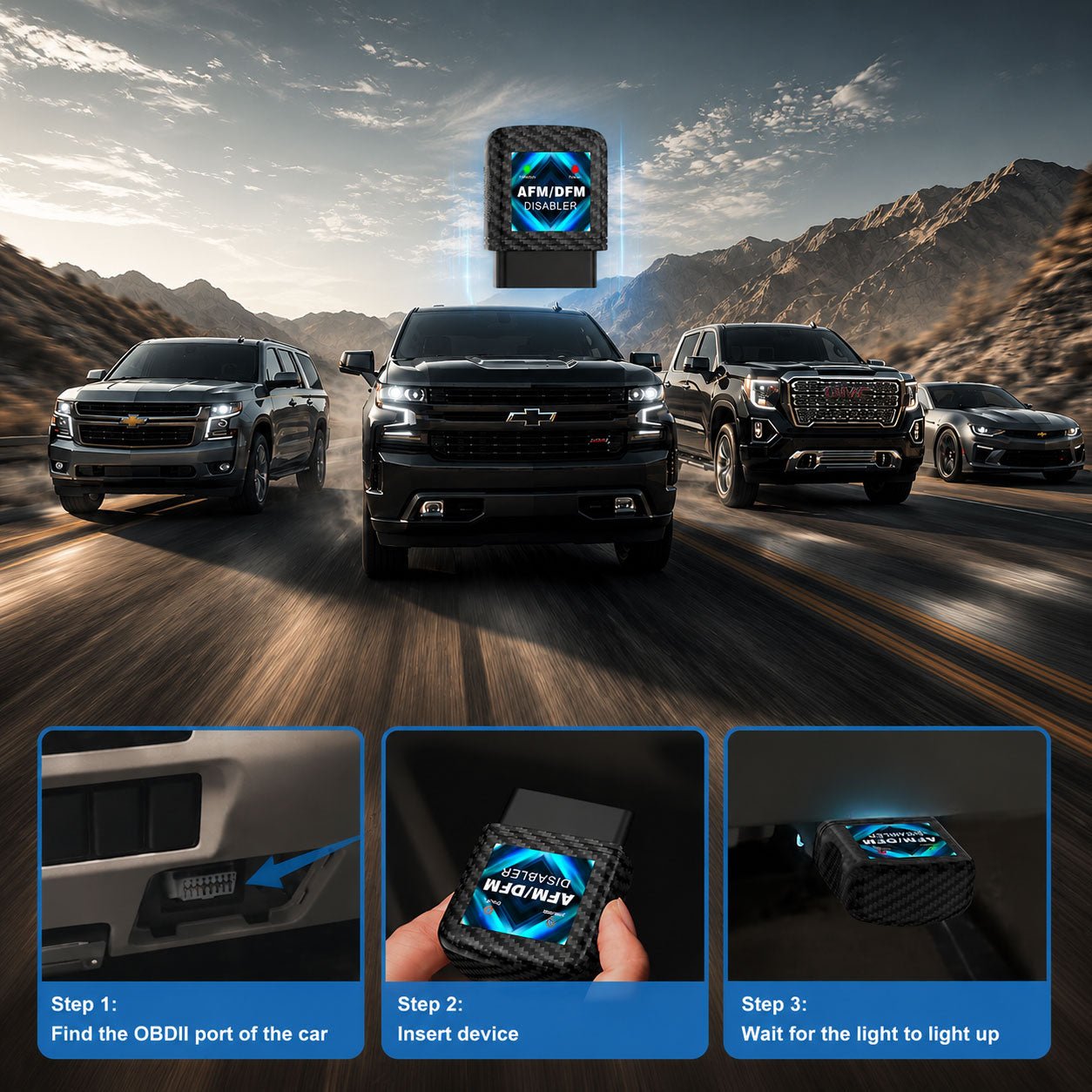
Simple installation, plug-and-play.
What Does an AFM/DFM Disabler Actually Do?
An AFM/DFM disabler is a plug-and-play device that connects through the vehicle’s OBD-II port and helps prevent the engine from entering cylinder deactivation mode.
This means your GM engine is more likely to remain in full-cylinder operation rather than switching between partial-cylinder modes under light load conditions.
However, it is important to understand:
It does NOT modify engine hardware
It does NOT reprogram the ECU
It does NOT repair existing engine issues
It is NOT the same as a Mechanical Repair
Instead, it focuses on changing how the engine operates during driving conditions.
Why Many Owners Say It Is Worth It
Most drivers consider an AFM/DFM disabler worth it for practical driving reasons rather than performance gains.
1. More consistent driving feel
Many GM owners report that cylinder deactivation transitions can feel noticeable in certain driving conditions. A disabler helps maintain a more stable engine behavior.
2. Reduced V4/V8 or DFM cycling
Instead of constantly switching operating modes, the engine stays in a more consistent state.
3. Better towing experience
When towing or carrying load, drivers often prefer predictable throttle and power delivery.
4. Plug-and-play convenience
No tuning, no ECU flashing, and no mechanical modifications are required.
5. Fully reversible
The device can be removed at any time, restoring factory operation.
Downsides You Should Know Before Buying
Like any aftermarket solution, there are trade-offs.
1. Fuel economy may decrease slightly
Since cylinder deactivation is reduced, some vehicles may experience minor MPG changes depending on driving conditions.
2. Compatibility is vehicle-specific
Not all GM vehicles use the same AFM/DFM generation, especially newer platforms.
3. Does not fix mechanical engine problems
If your vehicle already has issues such as lifter noise or misfires, a disabler will not repair them.
4. OBD-II port is occupied
While installed, the diagnostic port is in use.
5. Local regulatory and warranty considerations
Some regions (such as California) may have stricter regulations depending on modifications.

Compatible with various vehicle models; adaptable to diverse scenarios.
What Should Drivers Know About AFM/DFM Lifter Issues?
This is one of the most searched questions—and also one of the most misunderstood.
The honest answer is:
An AFM/DFM disabler may reduce cylinder deactivation activity while installed, but it cannot guarantee prevention of lifter failure or fix existing mechanical wear.
Lifter failure is a mechanical issue influenced by multiple factors such as maintenance history, engine wear, and operating conditions.
A disabler should be viewed as a driving behavior modification tool—not an engine repair solution.
AFM/DFM Disabler vs Plug-In Device vs Software Changes vs Mechanical Repair
| Option | Installation | Reversible | Complexity | Risk Level |
| AFM/DFM Disabler | Plug-and-play | Yes | Low | Low |
| Software-Based Changes | Software | Sometimes | Medium | Medium |
| Mechanical Repair | Mechanical | No | High | High |
For most daily drivers, the plug-and-play disabler is the simplest entry point.
Who Should Buy an AFM/DFM Disabler?
This solution is most suitable for GM owners who:
Drive Silverado, Sierra, Tahoe, Yukon, or Escalade models
Notice or dislike cylinder deactivation behavior
Tow trailers or drive under variable load
Want a reversible, non-permanent solution
Prefer plug-and-play installation over tuning

Who Should NOT Buy One?
This product may not be suitable if you:
Prioritize fuel economy above all else
Expect it to repair engine damage
Have unresolved engine warning lights or misfires
Are unsure about your vehicle’s compatibility and do not verify fitment
Must strictly comply with regional emissions requirements without modification considerations
Will Fuel Economy Drop?
There is no universal answer because MPG depends heavily on:
Driving style
Road conditions
Engine type
Tire setup
Vehicle load and towing behavior
In general:
Highway cruising may see more noticeable changes
City driving differences are often smaller
Which AFM/DFM Solution Is Right for You?
Different GM platforms may require different solutions:
Standard AFM/DFM Disabler → Most older AFM/DFM vehicles
DFM Module (Refresh trucks & SUVs) → Newer GM platforms (2021+ SUVs, 2022.5+ trucks)
Pulsar LT → Drivers wanting additional tuning control features
Start/Stop Disabler → For vehicles with auto start/stop systems
Choosing the correct solution depends heavily on vehicle year and platform generation.
Final Verdict: Is It Worth It?
For most GM truck and SUV owners, an AFM/DFM disabler is worth it if the goal is:
A more consistent driving experience
Reduced cylinder deactivation behavior
A plug-and-play, reversible solution
However, it is not a fix for mechanical engine issues, not intended to guarantee fuel-economy improvement.
The real value lies in driving consistency and user control—not engine repair or performance gains.
Before You Buy
Always verify:
Vehicle year
Model (Silverado, Sierra, Tahoe, Yukon, Escalade)
Engine platform (AFM vs DFM vs Refresh)
Then select the Correct Compatibility-based Solution.