How to Tell If Your GM Vehicle Has Active Fuel Management
If you drive a Chevrolet, GMC, or Cadillac vehicle, especially a Silverado, Sierra, Tahoe, Yukon, Suburban, or Escalade, there’s a good chance you’ve heard the term Active Fuel Management (AFM).
Most drivers don’t think about it until something feels “off” — a slight change in engine tone, a V4/V8 switching sensation, or after reading about AFM lifter issues online.
And then the real question comes up:
How do I actually know if my GM vehicle has AFM?
Let’s go through the real-world ways technicians and experienced GM owners check it — not guesswork, not forums myths.
Quick Answer: How Can You Tell If a Vehicle Has AFM?
You can confirm AFM in a GM vehicle using a combination of:
VIN or build sheet lookup
GM RPO code (factory option code)
Engine code identification
Dashboard V4/V8 behavior while driving
Model year + engine configuration check
In most cases, RPO code + engine code is the most reliable method, not just engine size or guesswork.

Why This Matters
AFM (Active Fuel Management) is GM’s cylinder deactivation system.
It allows the engine to run on fewer cylinders during light-load driving to improve fuel economy.
But here’s what most owners don’t realize:
Two trucks with the same engine size (like 5.3L V8) may NOT have the same AFM setup depending on year and platform.
That’s where confusion usually starts.
5 Practical Ways to Check If Your Vehicle Has AFM
Let’s go step-by-step.
1. Check VIN or Build Sheet
Your VIN alone doesn’t directly “show AFM” in plain text, but it can be used to pull:
Factory build sheet
Engine configuration
Option codes from GM database or dealer lookup
This is usually how dealerships confirm AFM/DFM.
👉 If you’re unsure, a VIN decoder or dealer service lookup is more reliable than guessing.
2. Look for GM RPO Codes (Most Accurate Method)
GM uses RPO (Regular Production Option) codes to define factory configuration.
AFM-equipped engines will appear in the RPO list depending on model year.
Common locations:
Glove box sticker (older models)
Spare tire area
Door jamb label
Dealer GM build sheet (newer models)
If you find engine-related RPO codes, that’s your strongest confirmation.
3. Identify the Engine Code
This is where experienced technicians usually start.
Common GM AFM-related engine codes include:
LMG – 5.3L V8 (AFM)
LC9 – 5.3L V8 (AFM)
L94 – 6.2L V8 (AFM)
L99 – 6.2L Camaro (AFM)
L83 – 5.3L EcoTec3 (AFM)
L86 – 6.2L EcoTec3 (AFM)
⚠️ Important:
Same displacement does NOT guarantee AFM. A 5.3L can be AFM or non-AFM depending on generation.
4. Watch for V4 / V8 Mode While Driving
This is the easiest real-world test.
While driving:
Maintain steady speed (40–70 mph / 60–110 km/h)
Light throttle
Listen carefully
If your vehicle has AFM, you may notice:
Engine tone changes slightly
Subtle vibration shift
Feeling like engine “relaxes” then “wakes up”
On some models, dashboard shows V4 / V8 mode
Many GM drivers describe it as:
“It feels like the truck changes character on the highway.”
That’s cylinder deactivation in action.

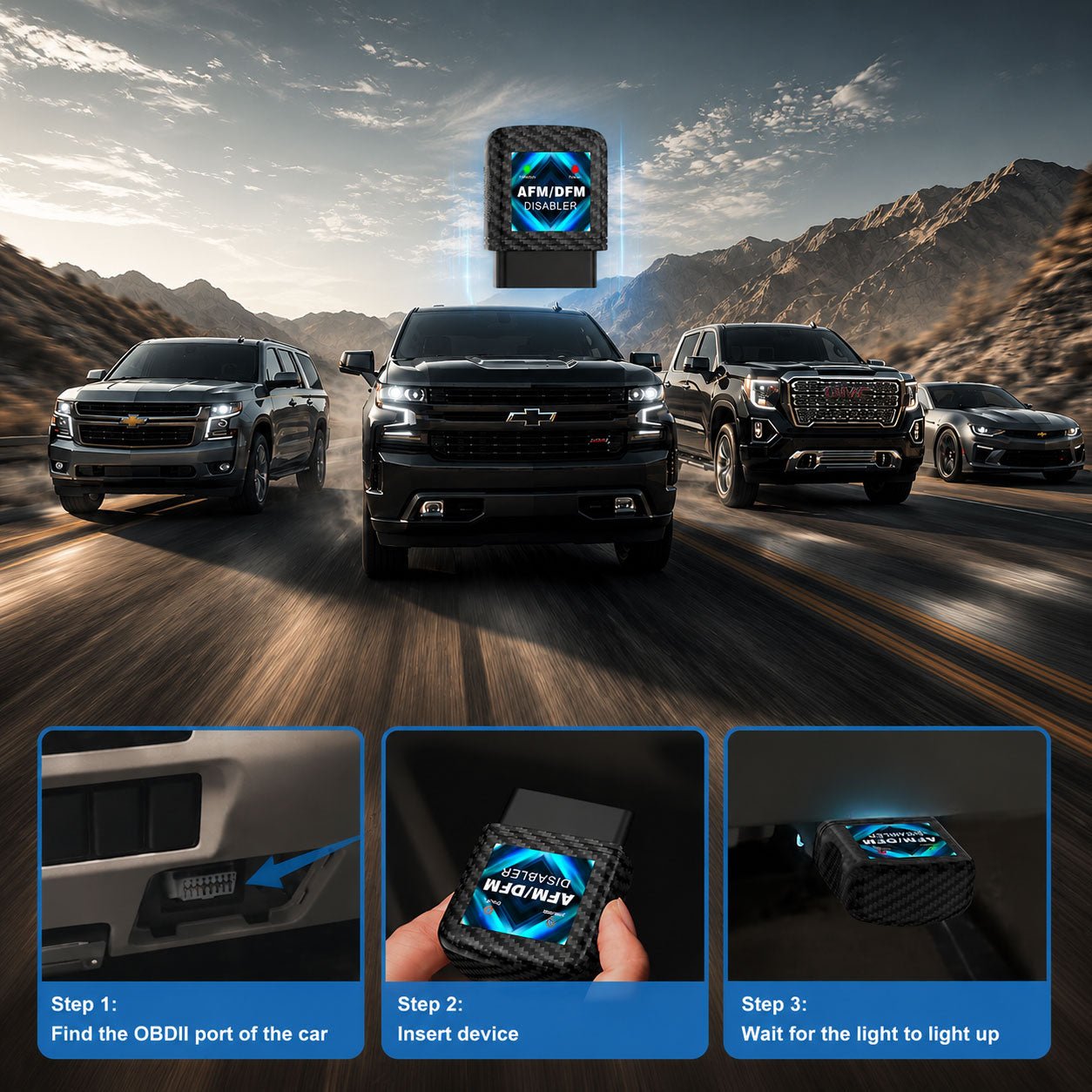
AFM/DFM Disabler Vehicle Compatibility Check
5. Check by Year + Model (Quick Reference)
While not perfect alone, year + model helps narrow it down:
Common AFM-equipped GM vehicles:
Chevrolet Silverado (select 2005+ V8 models)
GMC Sierra
Chevrolet Tahoe / Suburban
GMC Yukon / Yukon XL
Cadillac Escalade
Camaro SS (automatic V8 models)
But again:
You should always confirm with RPO or engine code — not just year.
AFM vs DFM (Don’t Confuse These)
If your vehicle is newer (especially 2019+), it may not use AFM anymore.
Instead it may use DFM (Dynamic Fuel Management).
Key difference:
AFM = switches between V8 and V4
DFM = more advanced system, can switch multiple cylinder combinations dynamically
So if you see newer GM trucks behaving more “fluid” in engine behavior, it may be DFM instead of classic AFM.
Why This Matters Before Buying an AFM/DFM Disabler
This is where most buyers get it wrong.
Before buying any device, you must confirm:
Is your vehicle AFM or DFM?
Is it a refresh platform (2022.5+ trucks / 2021+ SUVs)?
What engine code do you have?
Because:
AFM Disabler ≠ DFM Module
Using the wrong device may result in:
No effect
Compatibility issues
Misleading expectations
That’s why proper identification matters before purchase.
What If You’re Still Not Sure?
If you don’t want to dig into RPO codes or engine tables, the safest method is:
✔ Use VIN lookup
✔ Check build sheet
✔ Or use a compatibility checker before buying any device
This avoids 90% of wrong purchases.

Final Checklist (Fast Summary)
Before assuming your vehicle has AFM, confirm:
VIN/build sheet checked
RPO code identified
Engine code confirmed
Model year cross-checked
V4/V8 behavior observed
AFM vs DFM clarified
If 2–3 of these match, you likely have AFM or DFM system installed.
Final Thoughts
AFM is not something you can always confirm by guesswork — especially on GM trucks where the same engine size can have different configurations depending on year and platform.
That’s why technicians rely on RPO codes and engine codes, not assumptions.
And if your goal is to modify or disable AFM/DFM behavior later, correct identification is the first step before choosing any solution.